
Why choose the Edward S. Rogers Sr. Department of Electrical & Computer Engineering?
The fields of electrical and computer engineering are the engines that power the technology of the 21st century.
Think of any device with an energy or information technology component – that’s electrical and computer engineering. It plays a crucial role in everything from neuroscience to space exploration.
The Edward S. Rogers Sr. Department of Electrical & Computer Engineering (ECE) offers two undergraduate programs: Electrical Engineering and Computer Engineering, culminating in a Bachelor of Applied Science (BASc) degree upon graduation.
Admission Requirements
Program Overview

The first two years of study are your foundation and are the same for both electrical and computer engineering undergraduates. Our students learn the principles of their disciplines by attending courses taught by our world-renowned faculty and gain real-world experience working with companies and organizations related to their fields of interest.
During the first year, students need to complete 12 core courses. In the second year, they must complete 11 core courses as well as one hardware or software design and communication course.
Options available for full-time, extended full-time, part-time and co-op.

In your third and fourth years at ECE, you choose courses to determine whether you'll graduate in electrical or computer engineering. We have a range of areas of focus that integrate a variety of courses to offer a more specialized knowledge base.
In years three and four, students complete:
• Engineering Economics
• Capstone design project
• Four Breadth courses
• Four Depth courses
• Three Technical Electives
• One Science/Math Elective
• One Free Elective
• Four Humanities and Social Science (HSS) Electives (up to two from Complementary Studies)
Practical Experience Requirement (600 hours) or PEY Co-op is mandatory.
Machine Learning and Artificial Intelligence
Electric, Autonomous and Connected Vehicles
Quantum Computing
Cybersecurity, Privacy and Trust
Robotics and Control Systems
Smart Grid, Renewable Energy and Power Electronics
Digital Health
Wireless, Optical and Future Generation Communications (5G/6G)
Course Information
To see the full list of courses available to ECE undergraduates, information on the thesis course, ECE Iris and ineligible electives, please visit our Undergrad Course Information page.
Minors and Certificates
You may wish to complement your electrical and computer engineering programs with a minor or certificate. These will appear on your official student transcript when you graduate.
This is a great opportunity to gain interdisciplinary experience and to tailor your degree.
Are you interested in robotics?
Music technology? Entrepreneurship?
See the list of available minors and certificates, and learn about the benefits, eligibility and general requirements:
Hardware and Computer Labs
The hardware and computer labs at ECE provide practical skills and hands-on experience, which are essential to your undergraduate experience.
For information on lab regulations and accessing computers, please visit our Hardware & Computer Labs page.
Research and Undergrad Awards
- NSERC Undergraduate Student
- Research Awards (USRAs)
- University of Toronto Excellence Awards (UTEAs)
- Faculty Summer Research Awards
Undergraduate summer research awards are allocated by a competitive process to fund a student researcher to work with a professor over the summer.
Undergrad Student Experience
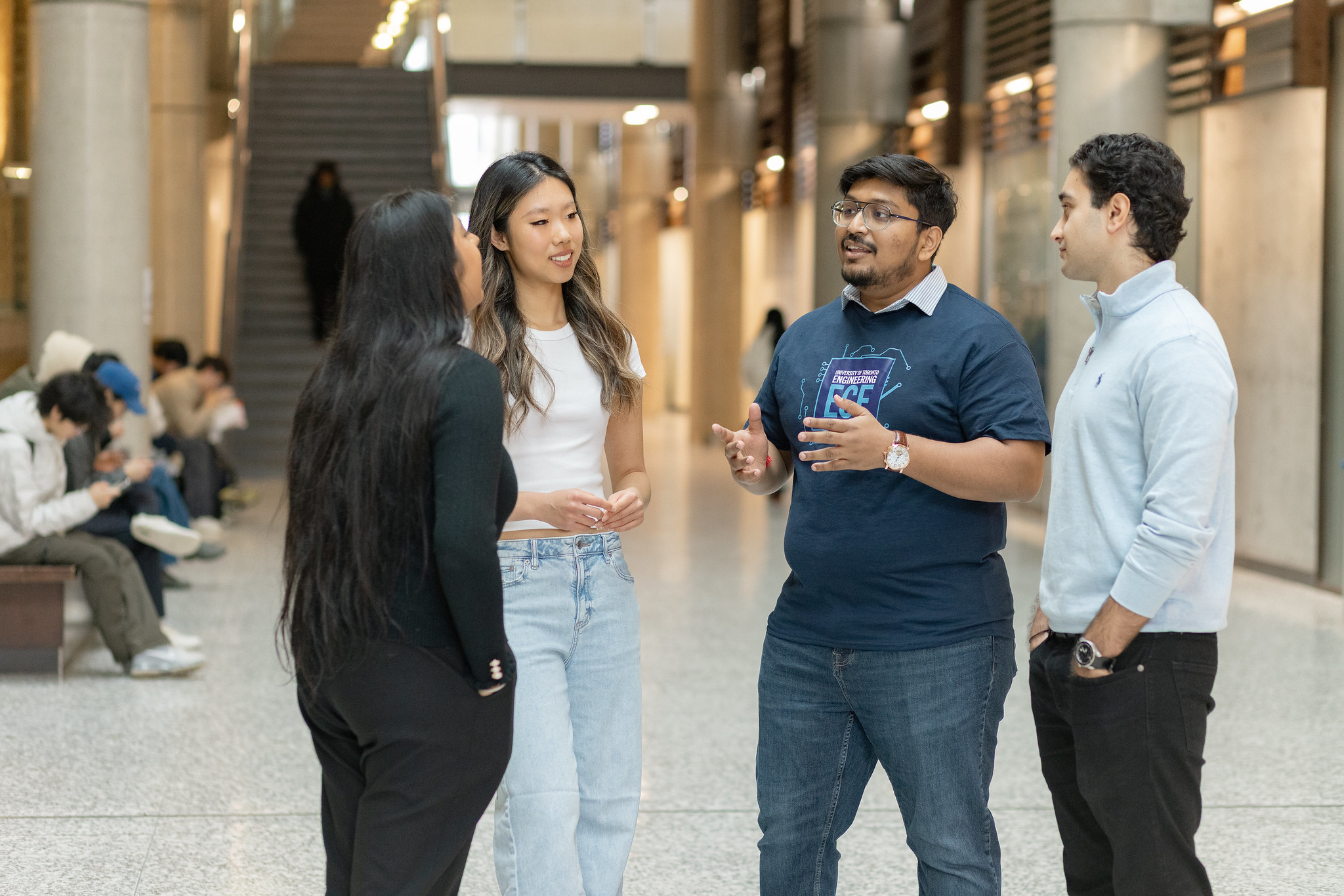
Student Life in ECE at U of T
Your U of T experience encompasses more than what happens in the classroom. Over 1,000 campus student organizations provide a great opportunity for you to meet new people, gain practical work experience and learn a new skill.
Visit the Student Life website or Ulife for the clubs and organizations database. Some clubs of interest to electrical and computer engineering students include: ECE Club, The Engineering Society, IEEE Club (Institute of Electrical and Electronics Engineers), National Society of Black Engineers, Troost ILead: Institute for Leadership Education in Engineering, Women in Science and Engineering and QueerSphere.
Student Stories: What our students are saying

"I’ve been really enjoying the course projects thus far; these experiences have been supporting my interpersonal and technical skills development while I've been learning about the different areas in ECE and within the broader engineering field."

"So far, my experience in ECE has been defined by a highly collaborative environment—rigorous, project-based courses, accessible and supportive faculty, and peers who are eager to share ideas—which makes the program both intellectually demanding and genuinely rewarding."
RESOURCES FOR UNDERGRADS
From academic support to mental health and financial aid, find resources for undergrads in U of T's engineering program.
Explore a new opportunity for Electrical & Computer Engineering students to go on an academic exchange at NTHU in Taiwan. Students are able to go on exchange in the Winter Semester of their third year. This would enable interested students to remain in Taiwan following their exchange for a research internship and/or a PEY Co-op internship before returning to U of T for their fourth year.
Students interested in applying, should review the application process guidelines before applying via the Learning Abroad platform.
Meet Our ECE Ambassadors
Meet our ECE ambassadors and learn about the undergraduate student experience.
Frequently Asked Questions
Contact
Undergraduate Program Inquiries
Email: askece@utoronto.ca
Tel: 416-978-0488
Location:
Sandford Fleming Building
Room SFB600
10 King's College Road
Toronto, ON